 Bernie Solutions
Products / Rockad
Rockad
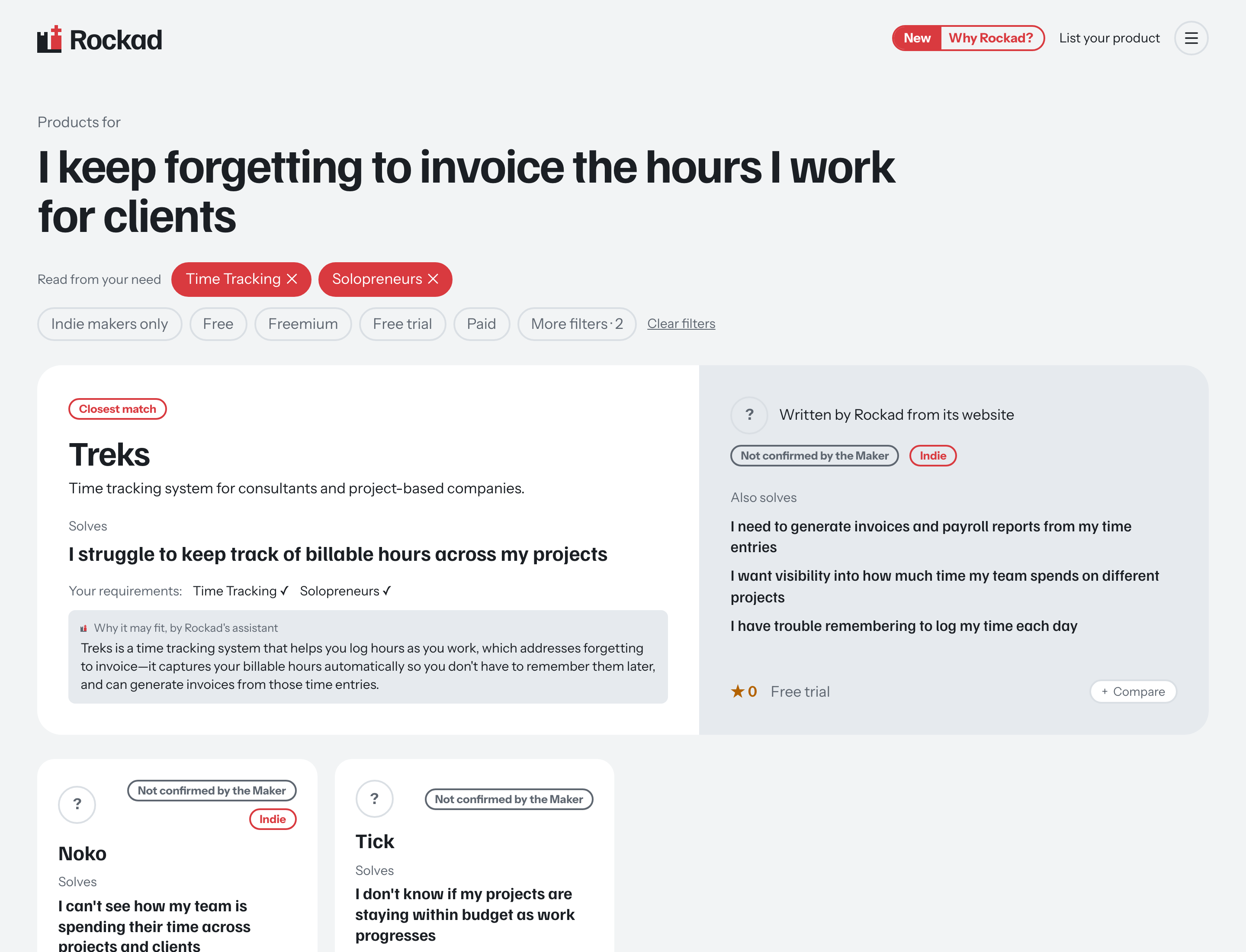
A place to find software by describing the problem you have, in your own words. I started building it on 1 October 2026, and it's live at rockad.io.
- 119 commits in six days
- 6 ADRs
- 85 test files
- 25 migrations
- Next.js 16, React 19, Tailwind, Supabase, pgvector
Why it exists
The working name was Flipit, because the idea was to flip things around. Usually it's the seller who goes looking for the buyer, with ads, sales people and paid visibility. On Rockad it starts with the person who has a problem: you write what's getting in your way and see who has already solved it.
I was thinking especially of small, independent makers who build good things but would rather build than sell. They should be able to get found anyway. That's why placement can't be bought, and the order depends only on how well a product fits what you described.
Search
Each product is described by a few problems it solves, written the way a user would say them. What you type is matched against those problems by meaning, not by words, with embeddings in Postgres.
If you write something like "for a team of five, on Mac", a language model reads that out as filters and shows them above the results. You see why something dropped out and can remove the filter.
Where AI gets to take part
Language models are used where they read or explain. They read filters out of what you wrote, explain why a result might fit and help makers with a first description. They never touch the order, because a model knows most about what's already known and marketed. The decision is written down in an ADR and applies to AI assistants too.
AI assistants can search directly
Rockad has an MCP server at rockad.io/mcp. An assistant like Claude can search for someone and gets the same results in the same order as the site, with a link to each product.
The catalogue
A maker enters their web address and gets a suggested description to edit before submitting it. Everything is reviewed before it shows. Products I've added myself are marked as unconfirmed until the maker takes them over, which is done with an email address on the product's domain or a DNS record.
How I've worked
The repo starts with a glossary of the domain, so that code, tests and copy use the same words. Bigger decisions are written down as ADRs. I've written the code together with Claude Code, and I've read every change.